Why Did Jesus Choose a Donkey for the Palm Sunday Journey?
The detail of the donkey is emphasized as part of a deliberate, prophetic action.
On Palm Sunday, the Gospels record Jesus’ entry into Jerusalem riding a donkey, greeted by crowds waving palm branches and shouting “Hosanna.” The event appears in all four Gospels (Matthew 21:1–11; Mark 11:1–10; Luke 19:29–40; John 12:12–19), where the detail of the donkey (or a colt) is emphasized as part of a deliberate, prophetic action.
This moment is the hinge that begins Holy Week: a public, visible claim about who Jesus is and what his mission will be.
For Catholics, the narrative is read not only as history but as a theologically charged sign, an enacted prophecy that points backward to Scripture and forward to the Paschal mystery.
Jesus’ choice of a donkey directly evokes Zechariah 9:9, which promises a king who comes “righteous and having salvation, gentle and riding on a donkey.”
The verse calls the people to rejoice as the King brings salvation, opening with the words, “Rejoice greatly, O daughter of Zion.” By entering Jerusalem in this way, Jesus intentionally identifies himself with the messianic hope of Israel while redefining what messianic kingship will look like. This is not a claim to earthly domination but a public enactment of a prophetic script that reframes power as service and salvation as humility.
The crowd’s acclamation. calling him “Son of David” and shouting blessings, shows that many onlookers understood the entry in messianic terms. Yet, the Gospels portray these expectations in tension with Jesus’ later passion, forcing readers to confront the difference between popular expectation and the cross-shaped reality of God’s saving work. They wanted a king; they received a Savior.
A king is short-term, but the Savior is for eternity.
The fact that Jesus entered Jerusalem on a donkey was itself a powerful statement: I am not the kind of king you desire, but I am a king after God’s heart. In many ways, this is why Jesus Christ was ultimately killed. He was not always palatable, liked, or accepted by the people. He challenged the norms of the time—the expectations of political power, the rigidity of certain religious structures, and the comfort of the status quo.
The donkey symbolizes humility and peace, in contrast to a war horse that would signal military conquest. By choosing a beast of burden rather than a stallion, Jesus models a kingship rooted in service and vulnerability. Catholic theology reads this as a decisive moment in which the nature of Christ’s reign... suffering love that conquers through self-gift, is made visible.
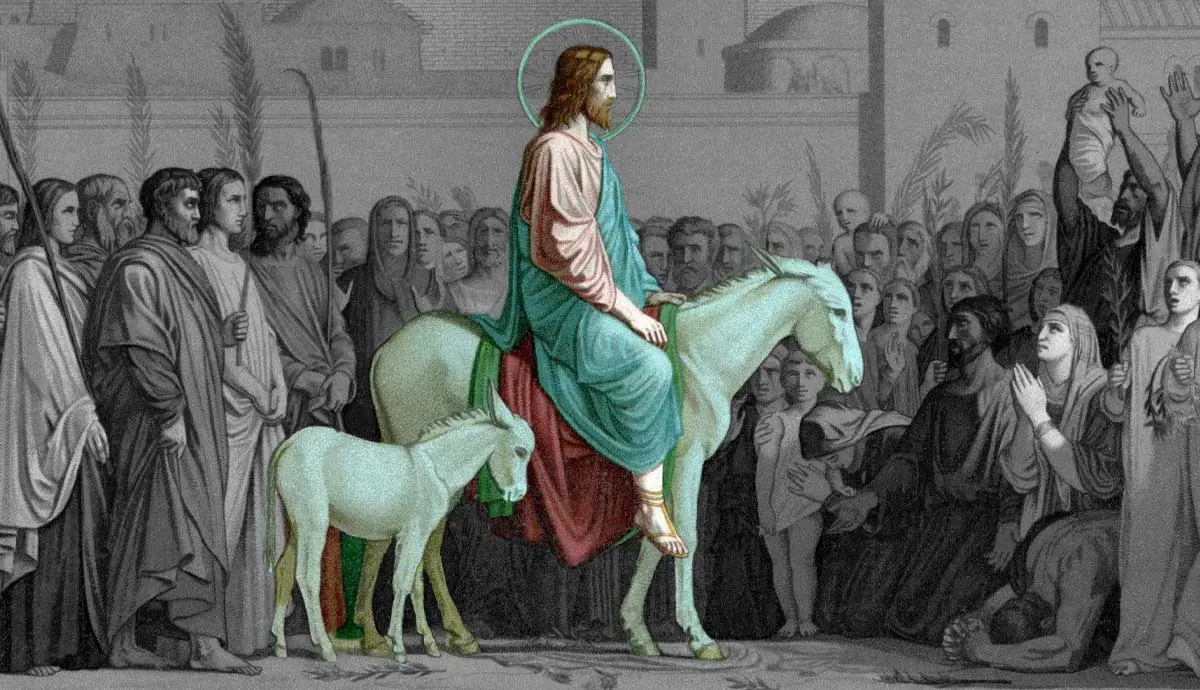
This paradox... king and servant, triumph and humility... becomes a catechetical tool. It teaches that true authority for the Christian is not coercive control but sacrificial love. The donkey, then, is not merely a quaint detail; it is a theological emblem that encapsulates the Gospel’s reversal of worldly values.
Palm Sunday inaugurates Holy Week in Catholic liturgy, and the procession with palms reenacts the crowd’s welcome. The ritual invites the faithful to enter the same tension the Gospel narrates: to acclaim Christ while preparing to accompany him to the cross. The palms themselves recall victory, but the victory celebrated is the Paschal victory - life through death - so the liturgy trains believers to see triumph through the lens of sacrifice.
Pastorally, the donkey entry offers a model for Christian leadership and discipleship. Priests, catechists, and lay leaders are reminded that authority in the Church is exercised in service, not domination. The procession and readings provide a yearly opportunity to reflect on how the community welcomes Christ and how it must be ready to follow him into the difficult realities of repentance, reconciliation, and self-giving love.
Jesus’ instructions to his disciples to fetch the donkey, “The Lord needs it,” turn a private act into a public sign. The entry is not merely symbolic; it is a prophetic performance. In the prophetic tradition, actions speak as loudly as words; Jesus’ arrival on a donkey is a deliberate, public claim that invites interpretation and response. For Catholics, this underscores the incarnational character of revelation: God acts in history, and those actions carry theological meaning.
Because the entry is public, it also exposes the fragility of human response. The same crowd that cries “Hosanna” will, within days, be swayed by other voices. The narrative thus becomes a sober reminder about the fickleness of popular opinion and the cost of discipleship when the Gospel’s demands run counter to social expectations.
Every element of the scene carries symbolic weight.
- Palms signify victory and honor.
- Cloaks spread on the road recall royal homage.
- The road itself, often read as the path to Jerusalem’s temple, becomes the path to the cross.
Together, these signs form a compact drama: the people’s gestures anticipate a conventional royal entry, but the outcome will invert that expectation. Catholic reflection reads these layers as an invitation to see sacramental meaning in ordinary signs and to recognize how God’s kingdom subverts worldly categories.
Palm Sunday is a communal memory that shapes Christian identity. Each year, the Church reenacts the entry to recall who Christ is and what following him entails. The donkey’s presence in that memory keeps the Church from mistaking spectacle for salvation; it insists that the center of Christian life is the Paschal mystery - Christ’s passion, death, and resurrection - rather than political triumph. This annual recollection forms believers to prefer the way of the cross over the seductions of power.
We assume that the donkey was returned to its rightful owner.